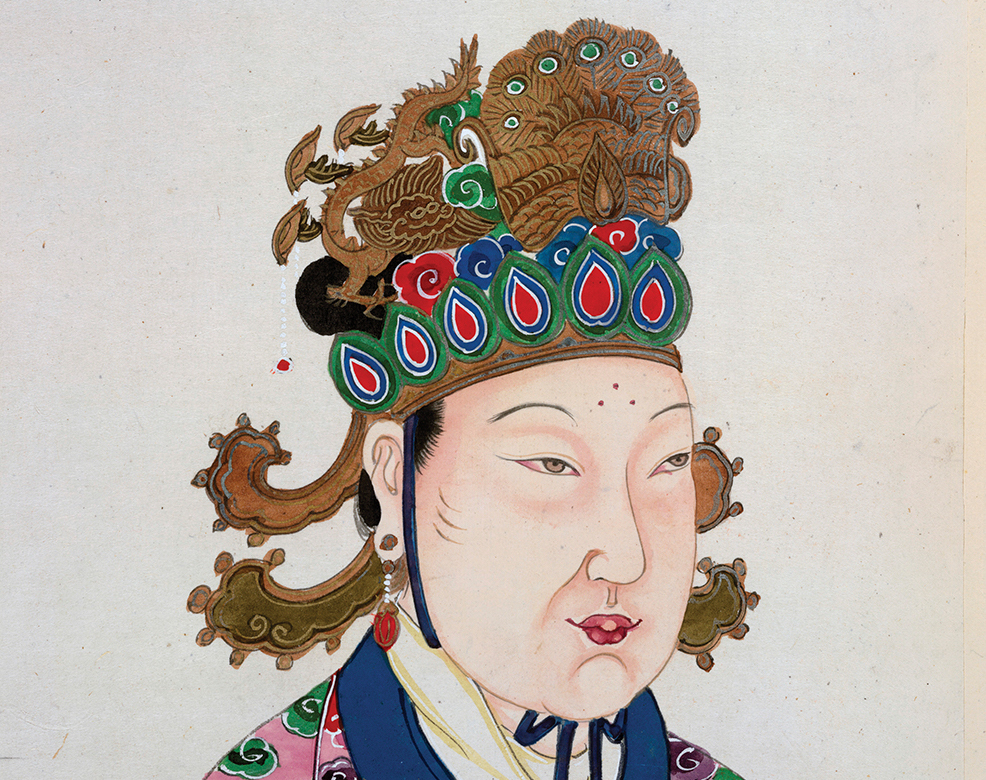
Wu Zhao 武曌, commonly known as Wu Zetian 武則天 (624-705), 18th cent. portrait, public domain.
This blogpost is part of an ongoing series.
Translator’s Remarks
Beginning with this post, I will produce a complete, chapter-by-chapter translation of the surviving parts of Key Points from the Treatises of Music (Yueshu yaolu 樂書要錄, c. 680). This treatise is special in many ways. To begin with, it the earliest extant Chinese monograph on music theory (tuning and the scale system) and one of the earliest extant monographs on music at large. Lucky for modern musicologists and pedagogues, Key Points as is available today—with 70% of its original content lost—is an excellent primer of Chinese music theory. As the title suggests, the treatise “compiles key points” yaolu 要錄 from the “Treatises of Music” yueshu 樂書, which are more commonly referred to as yuezhi 樂志 of the fifteen official dynastic histories zhengshi 正史 . Besides recording the musical institutions, tunings, ensembles, and song lyrics from the court of each dynasty, these treatises contain extensive discussions of key concepts such as pitch pipes, scales, metrology, calendar, and organology. By compiling these “key points” into a single book, Key Points is arguably the best introductory textbook possible for Classical Chinese music theory.
How Key Points survived was a poignant story of global history. According to Zhao Yuqing 赵玉卿 (Wenzhou University) in his 2004 monograph study, Key Points was lost in China by the thirteenth century. And we get to see 3 out of its 10 juan a juan 卷, literally “scroll,” is the conventional bibliographic counting unit in Classical Chinese bibliography—it may or may not coincide with the physical span of an actual “chapter,” “volume,” “gathering,” “binding,” but simply used for bibliographic record in full today only because a single copy was brought from China to Japan in 735, at a time when Tang-dynasty (618-907) China and Nara-period (710-790) Japan were closely connected through cultural and religious exchanges. In the 1800s, juan 5-7 of the treatise were printed in Japan in Collectanea of Surviving Books (Isson sōsho 佚存叢書 in Japanese ), an anthology of seventeen books lost in China yet preserved in Japan. It was through this publication that Key Points found its way back to China in the nineteenth century. While juan 1-4 and juan 8-10 appear to have been lost even in Japan, it seems not impossible to reconstruct their contents through philological methods: these parts of Key Points were quoted in several Japanese treatises from the Kamakura period (1185-1333), as Zhao Yuqing has shown.
Also remarkable its the authorship. Traditionally, Key Point is attributed to the only female emperor (Empress regnant, as opposed to Empress consort) in Chinese history, Wu Zhao 武曌 (624-705), commonly known as Wu Zetian 武則天. Both Collectanea of Surviving Books and Chinese bibliographic records indicate it to be “imperially written” chizhuan 敕撰 by her. Of course, like all books touting an imperial author, Key Points was not written by Empress Wu herself but by literati in her employment. Even so, the treatise was entangled with her political career. As Zhao Yuqing shows, the treatise was commissioned by Empress Wu in 675 and was completed by 689. It was during this period that Empress Wu became the de facto ruler due to the poor health and death of her husband, Emperor Gaozong (唐高宗, 628-683). It was also during this period that she kicked her son off the throne and installed her other son as a puppet (684) and massacred many members of the Tang’s imperial clan (688) in preparation for proclaiming herself emperor (690). Instrumental in implementing Empress Wu’s intrigues was a retinue of scholar-officials known as “North Gate Scholars” beimen xueshi 北門學士 . Besides advising Empress Wu and helping her consolidate power over the aristocracy and imperial bureaucracy, the North Gate Scholars compiled several treatises in Empress Wu’s name. These scholarly projects provided a cover for her machinations, but they also generated significant clout for her, covering such a wide range of topics from political ethics to rites and music—hence the birth of Key Points.
Translated in today’s post is the Table of Content and the preface-like first chapter of juan 5 of Key Points. You will see that, by the grace of fortune, the three surviving juan of the treatise make up a consistent whole. Juan 5, comprising 10 chapters, concerns the concept of sheng 聲 , a Chinese word that can mean “sound,” “musical sound,” “a note of the scale,” and “(human) voice.” Given its versatility—which cannot be done justice with any one English word—and its significance in Chinese music and sound culture, I have decided to leave the word sheng untranslated whenever it appears in Key Points. Juan 6, comprising 3 concepts, concerns the other key concept in Chinese music theory, lü 律 , which refers both to musical tuning in general and to the go-to instruments for studying tuning in specific: the twelve lülü 律呂 or tuning pitch pipes. Juan 7 combines sheng and tuning/tuning pitch pipes into a system of transpositions and melodic modes. In explaining these deceptively simple concepts, Key Points also discusses many topics that, though peripheral to “music theory” in the Anglophone world today, were no less important to Chinese music than tuning and scales: astronomy, geomancy, cosmology, and epistemology. And though Key Point was not known to any Chinese scholar during the 12th to 18th centuries, the text often appears prescient when compared to many important texts from this later period. Chapter 5:1 translated here, for example, describes the proper methodology and epistemology for studying music theory, in a way that anticipated Chapters 1:2 and 1:3 of Zhu Zaiyu’s A New Theory of Tuning (Lüxue xinshuo 律學新說, 1584)—the very chapters where Zhu Zaiyu proposed the world’s first twelve-tone equal temperament.
But was it really the first? Or should China’s only female emperor also be considered an “inventor of concept” of equal temperament? Read Key Points and find out!
Key Points from the Treatises on Music (c. 680), Table of Content
- Juan 1-4 [Lost]
- Juan 5 卷五
- Distinguishing the sheng of musical notes, examining the origin of sheng (辨音聲 審聲源);
- The method for the mutual generation of the seven sheng i.e. the seven notes of the heptatonic scale (七聲相生法);
- On how to understand the two bian 變, literally “altered” notes i.e. the biangong 變宮 and bianzhi 變徵 notes, which literally mean “altered gong note” and “altered zhi note,” which may give the specious impression that they are not “proper” notes on their own but merely the “altered” versions of two other notes (論二變義);
- On the paradigm of mutual generations (論相生類例);
- On “triple division with one part subtracted or added” being applicable to strings and pipes (論三分損益痛諸弦管);
- On the meaning of “mutual generation at every eighth step” (論歷八相生意);
- Understanding the succession of the seven sheng (七聲次第義);
- On how to understand that each transposition has its own hierarchy of notes (論每均自立尊卑義);
- Excerpts from the discussions of sheng from previous texts (敘自古書傳論聲義);
- The notation syllables (樂譜);
- Juan 6 卷六
- Records on the tuning pitch pipes lülü 律呂 (紀律呂);
- Understanding the calls and responses between Heaven and Earth embedded in the tuning pitch pipes (乾坤唱和義);
- Examining how to use reed ashes and pitch pipes to “Observer the Qi” houqi 候氣, an experiment using the purported cosmic correlations between pitch pipes and the solar terms (e.g. Winter Solstice) to set the calendar (審飛候)
- Juan 7 卷七
- The method for “rotating the gong” i.e. roughly “transpositions” among the tuning pitch pipes (律呂旋宮法);
- The method for hearing the sheng and the tuning pitch pipes (識聲律法);
- On how to understand that each pitch pipe encompasses seven sheng (論一律有七聲義).
- Juan 8-10 [Lost]
Chapter 5:1 “Distinguishing the sheng of musical notes, Examining the origin of sheng.”
In the beginning, The cosmic principle dao 道, which literally means “way” and refers in the philosophical sense “laws,” “principles,” “doctrines”—note that it is not just a concept unique to “Daoism,” but rather fundamental to many strands of Chinese thought produced qi 氣, which can mean both physical and metaphysical entities, from “air” and “breath” to “ether,” “spirit,” “vital force,” “solar terms” (e.g. Winter Solstice and Summer Solstice); in the philosophical sense used here, qi refers to the fundamental matter that makes up all things , and qi produced concrete forms xing 形; though often translated as “form,” xing should not be conflated with “Platonic forms” as though contrasted to matter; instead, it refers to the concrete, perceivable forms or manifestations of matter, which consists of qi .
(The Book of Rites Liji 禮記 (c. 1st century BCE), one of the three texts that constitute the “Canon of Rites” mentions “music that has no sheng i.e. music that comprises no sounds or notes” and “rite that has no ritual i.e. rite that comprises no specific ritual actions, movements, or protocols .” What is without ritual and without sheng is the cosmic principle dao . Hua Tan 華譚, a Chinese official, scholar, and philosopher from the 3rd century; though his writings were apparently still extant by the 10th century, they appear to have been lost by now argued: “What is without sheng is the ancestor of the five musical notes the five yin 音: gong, shang, jue, zhi, and yu, which together form effectively a pentatonic scale, roughly equivalent to do, re, mi, sol, and la . What is without concrete form is the sovereign of all things.” This is to say: one should trace back to the ancester and then the marvels of the shang note roughly equivalent to re and the zhi note roughly equivalent to sol will be mastered, and one should put the sovereign in order and then the appearances of both the glamorous and the simplistic will be made proper.)
The movement of concrete forms and the arousal of qi are whence sheng arise. And thus, froms and qi are the origin of sheng. Sheng can be varingly high or low, and this variance produces the different melodic modes. Yet these differently high or low ones amount to no more than twelve. If the qi of Heaven and Earth were all to be exhaled and become winds, the fast ones would be high in sheng, the slow ones would be low in sheng, the balanced ones would be medium in sheng. And even though melodic modes are plenty to the point of being bewildering, there are no more than twelve sheng A palpable shift in the meaning of sheng takes place here: in the previous paragraphs, sheng more or less refers to “sounds”; starting here, however, sheng begins to refers to musical notes in particular—otherwise it makes no sense to say that there are no more than twelve “sounds”! It is therefore important to keep in mind how sheng could mean both “sounds” and “musical notes,” in addition to “human voice.” .
Nonetheless, the sheng are not established in a void but are only manifestable by the means of instruments. In order to give names to sheng, the tuning pitch pipes lülü 律呂; here we shift from introducing sheng to introducing the other important concept in this primer at large: lü, which means both pitch pipes and musical tuning (as well as “laws,” “rules”) are therefore made. The twelve tuning pitch pipes lü 律 are the qi of Heaven and Earth and the sheng of the twelve months Each of the twelve lü is paired with one of the twelve non-intercalated months of the lunisolar Chinese calendar, specifically with the proper qi “solar term” of that month (Winter Solstice, for example, is the proper qi or solar term of the 11th Month, whereas Summer Solstice is the proper qi of the 5th Month); this pitch pipes–qi entanglement as related to the Chinese calendar will be explained in a later chapter . These pitch pipes constitute an infinite cycle and comprise the constant numbers of nature. Even though they were not portended by the Ultimate Supreme I am not exactly sure what this means. It appears to argue that the twelve tuning pitch pipes cannot be traced back to the “Ultimate Supreme” (taiji 太極), the origin of all things and principles that encompasses both being and non-being, both position and negation, both yang and yin. And yet, as future chapters of this primer will make clear, the twelve tuning pitch pipes embed a litany of cosmic correlations, hence why I am confused by this pronouncement here that “they were not portended by the Ultimate Supreme” , they still embed profound principles in them.
And yet, the phenomena of sheng are without concrete forms, hence difficult to record in writing. Granted, we can preserve their general gist in an imprecise manner by borrowing the calculations of lengths i.e. the lengths and proportions of the tuning pitch pipes measured in fen 分 or cun 寸; both fen and cun are units of length; one cun is in the same order of magnitude as one imperial inch, and one fen is typically defined as either 1/10 or 1/9 of one cun . Still, no one can exhaustively fathom the origin of music or tuning without playing with their own hands, chanting with their own mouth, listening with their own ears, or contemplating with their own mind. Therefore, Cai Yong 蔡邕 (132-192 CE), a key Confucian scholar of the Later Han (25-220 CE), a foundational period for Confucianism; Cai was a learned scholar in astronomy, mathematics, music, and literary compositions, though many of his writings appear to have been lost; notably, he composed Songs of the Qin Zither (Qincao 琴操), a book detailing the histories and/or legends concerning forty-seven renowned pieces of music for the seven-string zither, or qin 琴; this appears to be the earliest monograph on music (albeit not “music theory”) written in Chinese said in his Annotations of the chapter “Actions for Each Month” from the Book of Rites Yueling zhangju 月令章句; this text by Cai Yong annotates and comments on the chapter “Actions for Each Month” (Yueling 月令) from the Book of Rites (mentioned earlier); this chapter describes what a regime should do in terms of governance and rites in each month, including what type of melodic mode it should use and which one of the twelve tuning pitch pipes it should adapt as the “tonic” (the gong note, roughly equivalent to do) in its ritual music : “In the ancient time, those who instituted the musical tuning system based on bells used their own ears to adjust their sheng The traditional Classical Chinese historiography of music theory stipulated that, during the time of the ancients, which typically refer to before the 8th century BCE (i.e. before the end of the Western Zhou in 771 BCE), tuning was done with the assistance of bells; and only much later did tuning pitch pipes supplant the role of bells in being the go-to “instrument of music theory. While I do not know enough about Chinese musical archeology to arbitrate on this entrenched narrative, I do note that the earliest extant record on the origin of the tuning pitch pipes came rather late, in Chronicles of Master Lü (Lüshi chunqiu 呂氏春秋, 241 BCE), far later than many texts on tuning and bells . Later generations were no longer capable of the same, and thus they borrowed mathematics in order to rectify their measurements i.e. the lengths and sizes of bells and, later, pitch pipes : if measurements are rectified, they believed, then sheng will be rectified as well. By using measurements and numbers, studies of tuning can be recorded in writing, circulated by the words of mouth, and thus known by a large number of people. Nonetheless, they are not as precise as those determined by the ear” The exact same idea regarding the relation between sound and mathematics intersecting with the relation between ancient and modern is found in Chapter 1:2 of Zhu Zaiyu’s A New Theory of Tuning (Lüxue xinshuo 律學新說, 1584), right before his calculations of the twelve-tone equal temperament . These words are truly the wise saying of someone who understands music and the penetrating discourse of an intellect that has reached the level of the marvelous!
This work by Zhuqing (Lester) S. Hu is licensed under a Creative Commons Attribution-NonCommercial-NoDerivatives 4.0 International License. Original Chinese source in Public Domain: 樂書要錄·卷五.
 From the Reed Ashes Pavilion
3 thoughts on “Empress Wu’s Music Theory Primer — Key Points from the Treatises on Music (c. 680), Table of Content and Chapter 5:1 “Distinguishing the sheng of musical notes, examining the origin of sheng.””