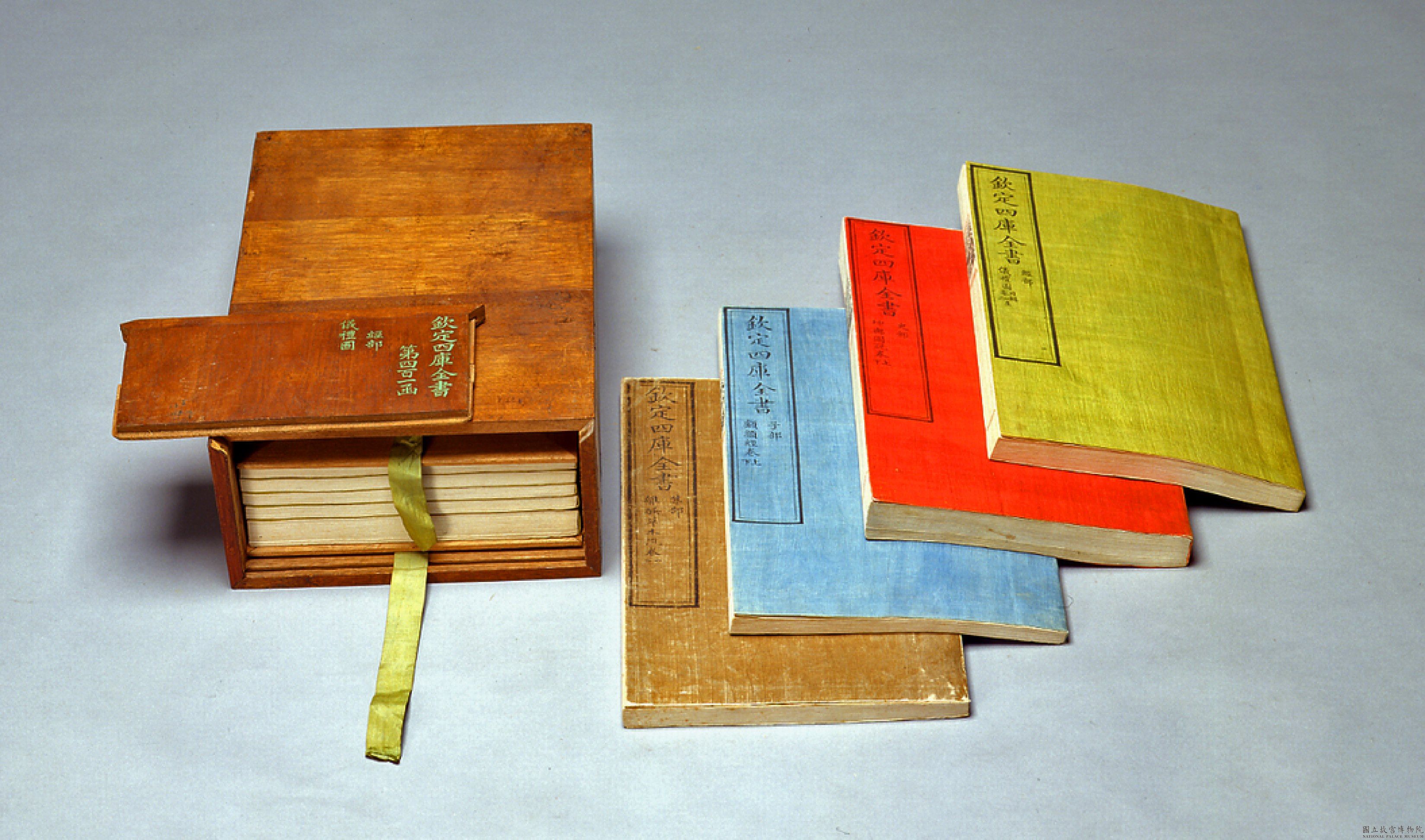
Image courtesy of 國立故宮博物院
Here below are listed, in the order of their first author, the various series of translations that I am currently pursuing, for quicker reference. These series only include translations as part of a larger whole, as opposed to, say, unrelated writings that just happen to come from the same source. Hence in most cases, the series listed here are entire treatises and/or long essays or chapters broken down into several blogposts. All titles/parts that have been translated are hyperlinked to the respective blogpost.
- Ji Yun 紀昀 et al., Summary Catalogue and Annotated Bibliography for the Complete Library in Four Sections (Siku quanshu zongmu tiyao 四庫全書總目提要, 1798), 200 juan
- Juan 38 “Confucian Canons” Section, “Music” Category (經部·樂類)
- Introduction
- Postface [in the same post as is the introduction]
- Juan 198 “Literary Anthologies” Section, “Lyrics and Arias” Category, Part One (集部·詞曲類一)
- Introduction
- Juan 38 “Confucian Canons” Section, “Music” Category (經部·樂類)
- Wu Zhao 武曌 et al., Key Points from the Treatises on Music (Yueshu yaolu 樂書要綠, c. 680), 10 juan, only juan 5, 6, and 7 extant.
- Juan 5
- Distinguishing the sheng of musical notes, examining the origin of sheng (辨音聲 審聲源);
- The method for the mutual generation of the seven sheng (七聲相生法);
- On how to understand the two bian notes (論二變義); [in the same post as the previous chapter]
- On the paradigm of the mutual generations (論相生類例);
- On “triple division with one part subtracted or added” being applicable to strings and pipes (論三分損益痛諸弦管); [in the same post as the previous chapter]
- On the meaning of “mutual generation at every eighth step” (論歷八相生意);
- Understanding the succession of the seven sheng (七聲次第義);
- On how to understand that each transposition has its own hierarchy of notes (論每均自立尊卑義);
- Excerpts from the discussions of sheng from previous texts (敘自古書傳論聲義);
- The notation syllables (樂譜);
- Juan 6
- Records on the tuning pitch pipes (紀律呂);
- Understanding the calls and responses between Heaven and Earth embedded in the tuning pitch pipes (乾坤唱和義);
- Examining how to use reed ashes and pitch pipes to “Observer the Qi” (審飛候);
- Juan 7
- The method for “rotating the gong” among the tuning pitch pipes (律呂旋宮法);
- The method for hearing the sheng and the tuning pitch pipes (識聲律法);
- On how to understand that each pitch pipe encompasses seven sheng (論一律有七聲義).
- Juan 5
This work by Zhuqing (Lester) S. Hu is licensed under a Creative Commons Attribution-NonCommercial-NoDerivatives 4.0 International License.
 From the Reed Ashes Pavilion