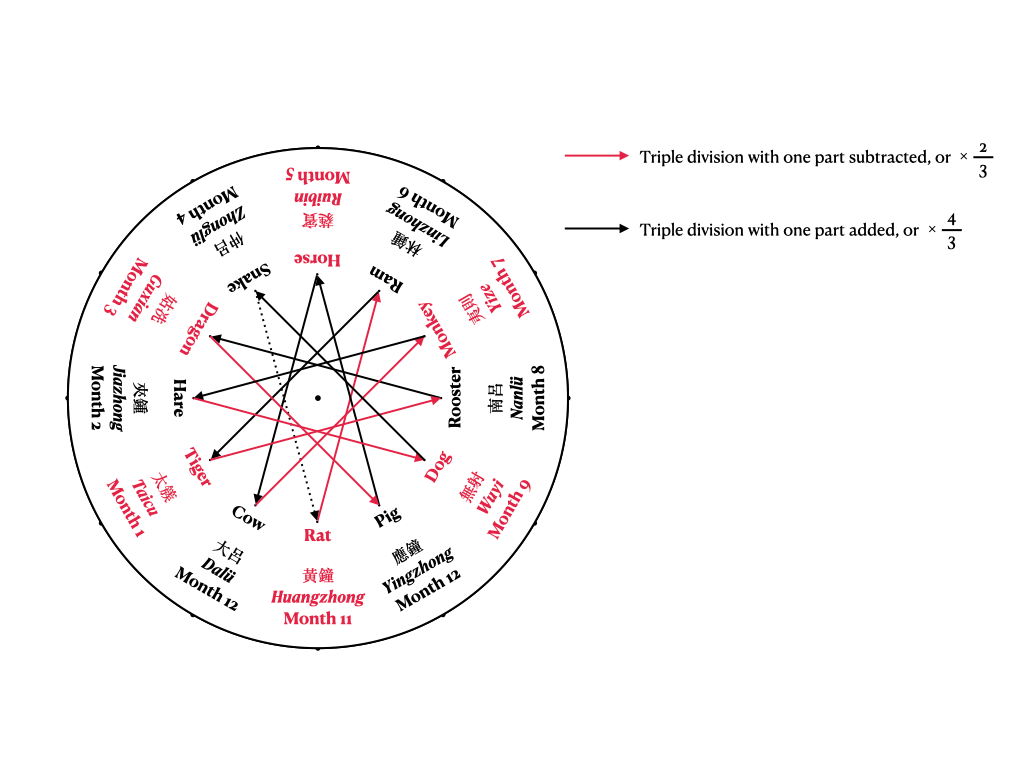
This is the third part of my translation of Key Points from the Treatises on Music (c. 680), or “Empress Wu’s Music Theory Primer.” These two chapters continue to discus the seven sheng, yet it also “previews” a significant concept in Chinese tuning theory in relation to the twelve tuning pitch pipes (or lü), before their proper treatment in juan 6 of the treatise: sanfen sunyi “triple division with one part subtracted or added.” This latter phrase describes the canonical method of computing the lengths of the twelve tuning pitch pipes, in which one pipe generates another in succession: specifically through the compounding multiplications by 2/3 and 4/3.
Tag Archives: rotating diagrams
What Pentatonicism? – Key Points from the Treatises on Music (c. 680), Chapter 5:2 “The method for the mutual generation of the seven sheng” and 5:3 “On how to understand the two bian notes”
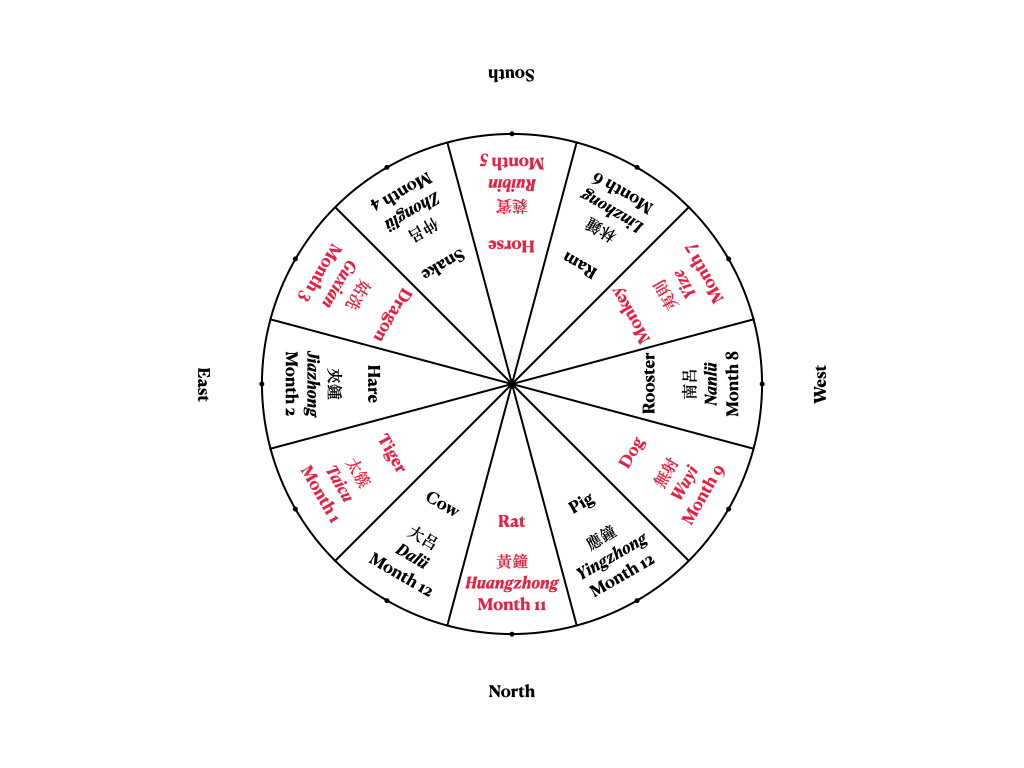
This is the second part of my translation of Key Points from the Treatises on Music (c. 680), or “Empress Wu’s Music Theory Primer.” These two chapters discuss the seven sheng or musical notes of the scale, particularly: (1) what are the topological relations or “mutual generations” between these seven notes vis-à-vis the twelve tuning pitch pipes, and (2) why, according to the here rather opinionated authors of Key Points, pentatonicism is not a thing and must never be a thing.
 From the Reed Ashes Pavilion