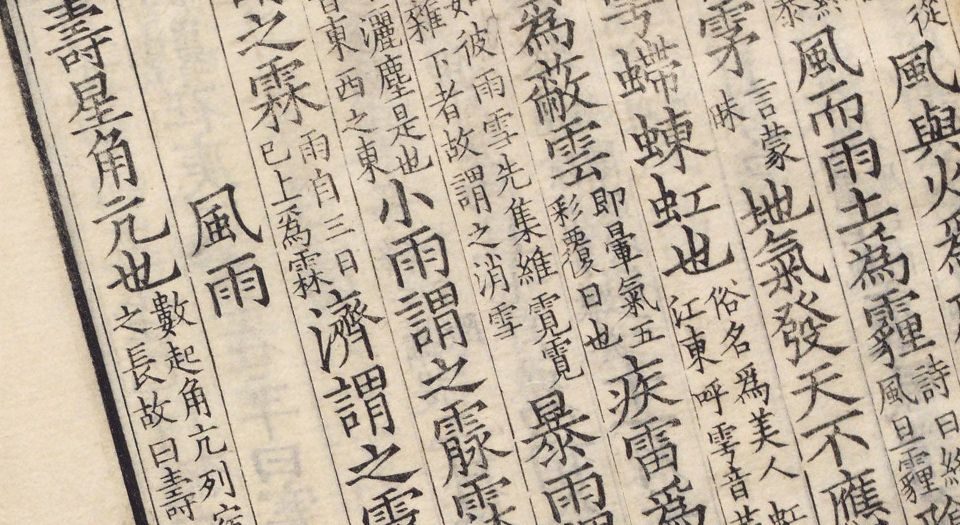
Here below are terms that frequently occur in Classical Chinese texts on music. Some of them are difficult to translate into English without losing sense of their radical linguistic and/or epistemological difference from the supposedly equivalent English word; in cases where such difference is quite jarring, I often choose to leave the Chinese word untranslated. As I rule, though, I still often explain these terms in my in-text annotations whenever they occur. The Chinese words are Latinized according to their Mandarin pronunciations transliterated in Pinyin.
Lülü 律呂 — tuning pitch pipes, musical tuning, music theory. Literally, lülü refer to the tuning pitch pipes, which are the go-to instruments used for studying tuning—particularly, the first lü 律 literally refers to the odd-number ones of the twelve tuning pitch pipes (roughly comparable to the twelve-tone chromatic scale, except they can and often do refer to literal pipes) and metrically all the tuning pitch pipes, whereas the second lü 呂 refers to the even-number ones of the twelve tuning pitch pipes. Because of their importance in the study of tuning, lülü, since at least Cai Yuanding’s A New Book on Pitch Pipes (Lülü xinshu 律呂新書, c. 1180), had become a metonym for the entire discipline of tuning and music theory at large.
Qi 氣 — air, gas, breath, spirit, appearance, vital force, cosmic matter, ether.
Sheng 聲 — sound, (human) voice, musical note. Particularly, the five sheng (wusheng 五聲 “five musical notes”) refer to the five notes of the pentatonic scale: gong 宮, shang 商, jue 角, zhi 徵, and yu 羽, which are roughly equivalent to do, re, mi, sol, and la. The seven sheng (qisheng 七聲 “seven musical notes”) adds to these five notes the two bian 變 “altered” notes: biangong 變宮 and bianzhi 變徵, which are roughly equivalent to ti and fa#, respectively. Both the five sheng and the seven sheng can also be called the five yin and the seven yin: in fact, despite subtle differences between the two sheng and yin 音 are often used somewhat interchangeably. Sheng is also the most often used word to refer to something akin to the voice: rensheng 人聲 (litreally “human sheng“) means the human voice.
Su 俗 — vulgar, popular, common-folk. Suyue 俗樂 “vulgar music” or “popular music” typically refers to music performed purely for entertainment purposes (which may also take place in a “courtly” context) as well as music enjoyed and/or practiced by the largely illiterate masses. Su is opposed to the ya 雅.
Ya 雅 — elegant, courtly, highbrow. Yayue 雅樂 “elegant music” is the Chinese cognate/etymology of Gagaku in Japanese, referring to the music specifically performed to accompany sacrificial rites and courtly ceremonies, often in the Confucian tradition. Ya as an adjective describes the decorous, courtly, ethically edifying, elevated, refined, and literary — as opposed to su 俗.
Yin 音 — sound, note, tone, pronunciation, dialect, musical note, timbre, class of musical instruments. As noted in the sheng 聲 entry, yin can be used interchangeably with sheng when referring to the five or seven notes of the scale. Bayin 八音 “The Eight Timbres” is, in contrast, a unique phrase in relation to yin: it refers to the traditional classification of instruments according to their materials—metal, stone, wood, leather, silk, bamboo, earth, and gourd.
Yue 樂 — music; when pronounced le — joy, delight, happiness; when pronounced yao — to take delight in.
This work by Zhuqing (Lester) S. Hu is licensed under a Creative Commons Attribution-NonCommercial-NoDerivatives 4.0 International License.
 From the Reed Ashes Pavilion